
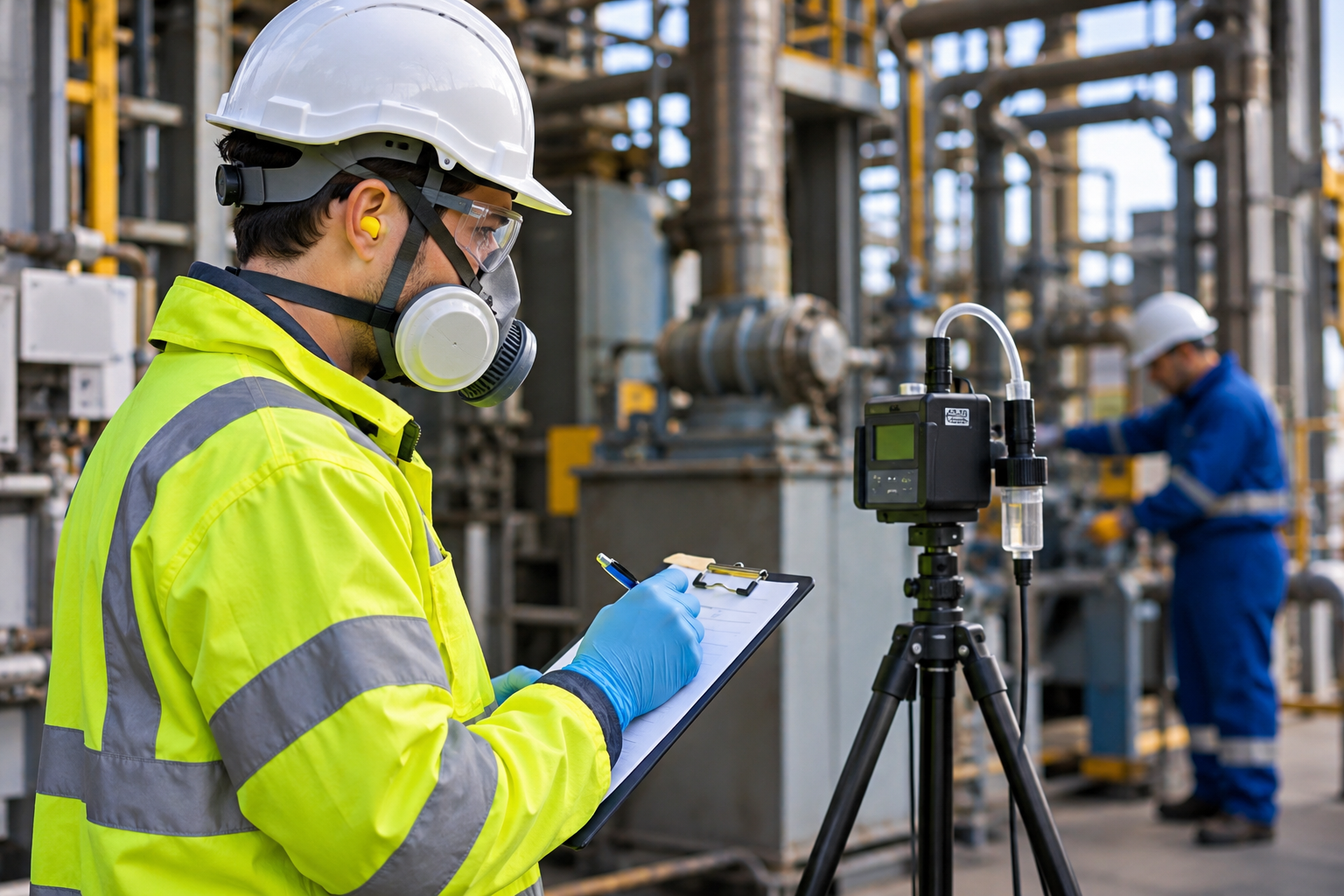
Level 5 Diploma in Advanced Industrial Hygiene and Occupational Exposure Assessment
Empowering professionals through accredited international qualifications.
Explore Other CoursesCourse Overview
The Level 5 Diploma in Advanced Industrial Hygiene and Occupational Exposure Assessment is designed to develop advanced knowledge and practical skills in identifying, evaluating, monitoring, and controlling workplace health hazards.
The qualification focuses on the principles and practices of industrial hygiene, including chemical exposure assessment, occupational noise, vibration, thermal stress, biological hazards, respiratory hazards, and workplace environmental monitoring.
Learners will develop the ability to conduct workplace exposure assessments, interpret monitoring results, evaluate occupational health risks, and recommend appropriate control measures in accordance with recognised industrial hygiene principles and occupational health and safety practices.
This qualification is particularly relevant to professionals responsible for workplace health protection, industrial hygiene programmes, occupational exposure monitoring, and the prevention of work-related illnesses.
Qualification Details
| Qualification Title | Level 5 Diploma in Advanced Industrial Hygiene and Occupational Exposure Assessment |
|---|---|
| Total Credits | 120 |
| Guided Learning Hours | 360 |
| Qualification Time | 1200 |
Applicants are normally expected to meet one of the following entry requirements:
-
A Level 4 Diploma in Occupational Health and Safety, Industrial Hygiene, Environmental Health, or a related discipline.
-
A relevant Level 4 qualification in HSE, engineering, environmental management, or occupational health.
-
A bachelor's degree in Occupational Health and Safety, Environmental Sciences, Chemistry, Engineering, or a related field.
-
Relevant professional experience in industrial hygiene, occupational health, workplace safety, or industrial operations may also be considered.
Applicants should preferably have a basic understanding of workplace health and safety principles.
Unit 1: Advanced Principles of Industrial Hygiene
Unit Description:
This unit introduces advanced concepts of industrial hygiene and the systematic management of occupational health hazards. Learners will explore hazard anticipation, recognition, evaluation, and control within different industrial environments.
Topics Covered:
-
Fundamentals and principles of industrial hygiene
-
Role and responsibilities of industrial hygienists
-
Occupational health hazard identification
-
Workplace health hazard assessment
-
Industrial processes and exposure sources
-
Occupational health risk evaluation
-
International industrial hygiene practices
-
Occupational health legislation and standards
Learning Outcomes:
Learners will be able to:
-
Explain advanced principles and practices of industrial hygiene.
-
Identify potential occupational health hazards in industrial environments.
-
Evaluate workplace activities and processes for health-related risks.
-
Explain the role of industrial hygiene in occupational health protection.
Unit 2: Chemical Hazards and Occupational Toxicology
Unit Description:
This unit develops learners' understanding of chemical hazards, toxicological principles, and the health effects associated with occupational exposure to hazardous substances. It focuses on evaluating chemical exposure risks and understanding how hazardous substances affect human health.
Topics Covered:
-
Classification of occupational chemical hazards
-
Principles of occupational toxicology
-
Routes of chemical exposure and absorption
-
Acute and chronic health effects
-
Toxic substances and hazardous materials
-
Carcinogens, mutagens, and reproductive toxins
-
Safety Data Sheets (SDS) and chemical labelling
-
Chemical exposure limits and risk evaluation
-
Chemical exposure prevention strategies
Learning Outcomes:
Learners will be able to:
-
Classify chemical hazards found in industrial workplaces.
-
Explain the toxicological effects of hazardous substances.
-
Evaluate occupational exposure routes and associated health risks.
-
Interpret chemical safety information and exposure limits.
Unit 3: Occupational Exposure Monitoring and Assessment
Unit Description:
This unit focuses on the methods and techniques used to assess and monitor occupational exposure to hazardous substances. Learners will develop knowledge of workplace sampling strategies, monitoring instruments, exposure data interpretation, and occupational exposure assessment procedures.
Topics Covered:
-
Principles of occupational exposure assessment
-
Personal and area air sampling techniques
-
Workplace exposure monitoring strategies
-
Airborne contaminants and particulate sampling
-
Gas and vapour monitoring methods
-
Direct-reading instruments and monitoring equipment
-
Occupational Exposure Limits (OELs)
-
Time-Weighted Average (TWA) and Short-Term Exposure Limits (STELs)
-
Sampling quality assurance and calibration
-
Interpretation of monitoring results
Learning Outcomes:
Learners will be able to:
-
Develop appropriate occupational exposure monitoring strategies.
-
Explain personal and workplace environmental sampling techniques.
-
Identify suitable monitoring equipment for different exposure hazards.
-
Interpret occupational exposure monitoring data against relevant exposure criteria.
Unit 4: Physical and Biological Workplace Hazards
Unit Description:
This unit examines the impact of physical and biological agents on workers' health. Learners will study the assessment and monitoring of noise, vibration, heat, radiation, biological contaminants, and other workplace environmental hazards.
Topics Covered:
-
Occupational noise exposure and assessment
-
Whole-body and hand-arm vibration
-
Thermal stress and workplace heat exposure
-
Ionising and non-ionising radiation hazards
-
Workplace lighting and environmental conditions
-
Biological hazards and occupational infections
-
Moulds, bacteria, viruses, and biological aerosols
-
Ergonomic health hazards and musculoskeletal risks
-
Environmental monitoring and workplace health evaluation
Learning Outcomes:
Learners will be able to:
-
Identify physical and biological hazards in different working environments.
-
Evaluate the potential health effects of physical and biological exposures.
-
Explain monitoring techniques for workplace physical hazards.
-
Recommend appropriate measures to prevent occupational health risks.
Unit 5: Advanced Exposure Control and Risk Management
Unit Description:
This unit focuses on the development and implementation of effective strategies for controlling occupational exposures. Learners will explore engineering controls, administrative measures, respiratory protection, and the application of the hierarchy of controls to minimise workers' exposure to hazardous agents.
Topics Covered:
-
Principles of occupational exposure control
-
Hierarchy of hazard control measures
-
Engineering controls and ventilation systems
-
Local Exhaust Ventilation (LEV)
-
Chemical containment and isolation systems
-
Administrative exposure control measures
-
Respiratory protective equipment programmes
-
Personal protective equipment selection
-
Control effectiveness evaluation
-
Exposure reduction and prevention strategies
Learning Outcomes:
Learners will be able to:
-
Evaluate existing workplace exposure control measures.
-
Recommend appropriate engineering and administrative controls.
-
Explain the selection and application of respiratory protection.
-
Develop strategies for reducing occupational exposure risks.
Unit 6: Occupational Hygiene Programmes and Professional Reporting
Unit Description:
This unit develops learners' ability to establish, implement, and review occupational hygiene programmes. It focuses on workplace hygiene planning, exposure records, monitoring reports, health surveillance coordination, and continuous improvement of occupational health protection systems.
Topics Covered:
-
Development of occupational hygiene programmes
-
Workplace exposure assessment planning
-
Occupational health surveillance coordination
-
Exposure monitoring records and documentation
-
Industrial hygiene audit and inspection procedures
-
Occupational hygiene data analysis
-
Preparation of professional exposure assessment reports
-
Communication of monitoring findings
-
Review of exposure control effectiveness
-
Continuous improvement of workplace health programmes
Learning Outcomes:
Learners will be able to:
-
Develop occupational hygiene monitoring and management programmes.
-
Maintain and evaluate occupational exposure assessment records.
-
Prepare professional industrial hygiene assessment reports.
-
Recommend improvements to workplace occupational health programmes.
The Level 5 Diploma in Advanced Industrial Hygiene and Occupational Exposure Assessment offers several professional and academic benefits:
1. Advanced Professional Knowledge: Develop specialised knowledge of industrial hygiene and occupational exposure assessment.
2. Workplace Hazard Assessment: Gain the ability to identify and evaluate chemical, physical, and biological health hazards.
3. Exposure Monitoring Skills: Understand workplace sampling, monitoring equipment, and exposure data interpretation.
4. Improved Workplace Health Protection: Learn to recommend effective measures to minimise occupational exposure and prevent work-related illnesses.
5. Professional Development: Strengthen technical knowledge for individuals working in HSE, occupational health, and industrial hygiene.
6. Career Advancement: Build a foundation for progression into more specialised occupational hygiene and workplace health management roles.
This qualification is suitable for:
-
Health and Safety Officers
-
HSE Engineers and HSE Supervisors
-
Industrial Hygiene Technicians
-
Occupational Health and Safety Professionals
-
Environmental Health and Safety Officers
-
Occupational Health Practitioners
-
Chemical Safety Professionals
-
Industrial Safety Consultants
-
Workplace Exposure Assessment Personnel
-
Manufacturing and Process Industry Professionals
-
Oil and Gas HSE Personnel
-
Professionals involved in workplace health monitoring
The qualification is designed around assignment-based assessment to evaluate learners' theoretical knowledge, analytical abilities, and practical understanding of industrial hygiene.
-
Six unit-based assignments.
-
Each assignment should assess the relevant unit learning outcomes.
-
Workplace case studies and practical examples should be incorporated.
-
A final occupational exposure assessment project may be included.
To deliver this Qualification, HiQual UK Approved ATPs must demonstrate the capability to deliver, assess, and internally quality assure qualifications in line with recognised regulatory principles and the expectations of the Regulated Qualifications Framework (RQF).
Approved centres must operate effective systems to ensure the validity, reliability, fairness, consistency, and security of assessment.
1. Centre Recognition and Legal Compliance
Centres must be formally recognised by HiQual UK prior to the delivery or assessment of any
qualification. To maintain recognition, centres must:
Be a legally constituted organisation operating in compliance with applicable legislation and
regulatory
requirements.
Demonstrate effective governance, management oversight, and clear lines of accountability.
Comply with all HiQual UK policies, procedures, and conditions of centre recognition.
Notify HiQual UK promptly of any material changes that may affect delivery, assessment, or internal
quality assurance arrangements.
2. Resources, Facilities, and Learning Environment
Centres must ensure that sufficient and appropriate resources are in place to support learning and
assessment. This includes:
Learning environments appropriate to the mode of delivery, including classrooms and, where
applicable,
specialist or practical facilities.
Access to learning and assessment resources that enable learners to meet qualification outcomes.
Secure systems for managing learner data, assessment records, and certification claims.
Arrangements that support equality of access and reasonable adjustments for learners where required.
3. Staff Competence and Occupational Expertise
Centres must ensure that all staff involved in delivery, assessment, and internal quality assurance
are
competent and suitably qualified. Centres must:
Appoint tutors with appropriate subject knowledge, teaching competence, and relevant occupational or
professional experience.
Ensure assessors are trained and competent in applying HiQual UK assessment requirements and
standards.
Appoint a qualified Internal Quality Assurer (IQA) responsible for monitoring assessment practice
and
decisions.
Maintain records of staff qualifications, experience, training, and continuing professional
development
(CPD).
4. Assessment Practice and Internal Quality Assurance (IQA)
Centres must operate robust internal quality assurance systems to ensure assessment integrity.
Centres
must:
Ensure assessment is valid, fit for purpose, and conducted in line with HiQual UK requirements.
Implement effective IQA procedures to monitor assessor performance and confirm the consistency of
assessment decisions.
Maintain accurate, complete, and auditable records of learner registration, assessment evidence, and
outcomes.
Carry out regular internal reviews and standardisation activities to support continuous improvement.
5. Integrity, Risk Management, and Malpractice
Centres must take appropriate measures to protect the integrity of assessment. Centres must:
Maintain policies and procedures for the prevention, identification, and management of malpractice
and
maladministration.
Ensure secure handling, storage, and retention of assessment materials and learner evidence.
Report any suspected or confirmed malpractice to HiQual UK in accordance with published procedures.
6. Health, Safety, Safeguarding, and Learner Protection
Centres must provide a safe, inclusive, and supportive learning environment. Centres must:
Comply with applicable health and safety and safeguarding legislation.
Conduct risk assessments for learning activities, particularly where practical or technical work is
involved.
Maintain procedures to safeguard learner welfare and wellbeing.
7. Learner Information, Support, and Fair Treatment
Centres must ensure learners are informed, supported, and treated fairly. Centres must:
Provide clear and accurate information on programme requirements, assessment methods, and
certification.
Ensure learners receive timely and constructive feedback on assessment outcomes.
Operate transparent complaints and appeals procedures aligned with HiQual UK requirements.
Manage learner information securely in compliance with data protection legislation.
After successfully completing the Level 5 Diploma in Advanced Industrial Hygiene and Occupational Exposure Assessment, learners may consider progressing towards:
-
Level 6 Diploma in Occupational Health and Safety.
-
Level 6 Diploma in Environmental Management.
-
Advanced qualifications in Occupational Hygiene.
-
Professional certifications in Industrial Hygiene and Exposure Assessment.
-
Specialised training in Occupational Toxicology.
-
Advanced studies in Environmental and Occupational Health.
-
Relevant bachelor's or postgraduate programmes, subject to institutional admission requirements.
The qualification may also support professional development towards specialised roles in occupational hygiene, exposure monitoring, and workplace health risk management.
Frequently Asked Questions
Find answers about this qualification, assessment and certification.
Applicants are normally expected to meet one of the following entry requirements:
-
A Level 4 Diploma in Occupational Health and Safety, Industrial Hygiene, Environmental Health, or a related discipline.
-
A relevant Level 4 qualification in HSE, engineering, environmental management, or occupational health.
-
A bachelor's degree in Occupational Health and Safety, Environmental Sciences, Chemistry, Engineering, or a related field.
-
Relevant professional experience in industrial hygiene, occupational health, workplace safety, or industrial operations may also be considered.
Applicants should preferably have a basic understanding of workplace health and safety principles.
The Level 5 Diploma in Advanced Industrial Hygiene and Occupational Exposure Assessment offers several professional and academic benefits:
1. Advanced Professional Knowledge: Develop specialised knowledge of industrial hygiene and occupational exposure assessment.
2. Workplace Hazard Assessment: Gain the ability to identify and evaluate chemical, physical, and biological health hazards.
3. Exposure Monitoring Skills: Understand workplace sampling, monitoring equipment, and exposure data interpretation.
4. Improved Workplace Health Protection: Learn to recommend effective measures to minimise occupational exposure and prevent work-related illnesses.
5. Professional Development: Strengthen technical knowledge for individuals working in HSE, occupational health, and industrial hygiene.
6. Career Advancement: Build a foundation for progression into more specialised occupational hygiene and workplace health management roles.
The qualification is designed around assignment-based assessment to evaluate learners' theoretical knowledge, analytical abilities, and practical understanding of industrial hygiene.
-
Six unit-based assignments.
-
Each assignment should assess the relevant unit learning outcomes.
-
Workplace case studies and practical examples should be incorporated.
-
A final occupational exposure assessment project may be included.
This qualification is suitable for:
-
Health and Safety Officers
-
HSE Engineers and HSE Supervisors
-
Industrial Hygiene Technicians
-
Occupational Health and Safety Professionals
-
Environmental Health and Safety Officers
-
Occupational Health Practitioners
-
Chemical Safety Professionals
-
Industrial Safety Consultants
-
Workplace Exposure Assessment Personnel
-
Manufacturing and Process Industry Professionals
-
Oil and Gas HSE Personnel
-
Professionals involved in workplace health monitoring
Related Qualifications

Level 1 Award in Basic Health and Safety Awarness
View Level 1 Award in Basic Health and S...
Level 2 Award in Health and Safety at Workplace
View Level 2 Award in Health and Safety...